

Listen to the article
Bitcoin’s hashrate is near record levels, yet miner revenue per unit of compute has fallen to record lows, pushing the network into a ‘high-security, low-profitability’ phase.
While the network’s hashrate has pinned itself above the one-zettahash watermark, which is a record for aggregate computing power, the revenue underpinning that security has disintegrated to historic lows.
Still, the system appears robust to the protocol. However, the mining sector is undergoing a slow-motion liquidation in the capital markets.
Bitcoin mining difficulty folds, hashrate holds
According to Cloverpool data, Bitcoin mining difficulty slipped approximately 2% at block height 925,344 on Nov. 27 to 149.30 trillion. This was the second consecutive decline this month, yet block intervals remain stubbornly close to the ten-minute target.
This falling difficulty coincides with a period where Bitcoin mining economics have become increasingly punishing.
Hashprice, the industry’s metric for daily revenue per unit of compute, has collapsed almomst 50% in recent weeks to an all-time low near $34.20 per petahash per second. At this valuation, the average operator’s gross margins have evaporated.
Nico Smid, the founder of Digital Mining Solution, explained that this means fleets running hardware with an efficiency below 30 joules per terahash now require all-in power costs below 5 cents per kilowatt-hour to break even, once rent, labor, and maintenance are factored in.
This threshold has forced a bifurcation, where thousands of older rigs are going dark, only to be immediately offset by industrial-scale deployment.
However, this does not explain why total hashrate has barely budged and why aggregate security work remains above one zettahash.
The answer lies in the fleet’s composition. Small miners without access to cheap power are capitulating. On the other hand, deep-pocketed operators with long-term power purchase agreements (PPAs), sovereign-linked facilities, or off-grid generation are holding steady or expanding.
For context, stablecoin issuer Tether has reportedly halted its mining venture in Uruguay, citing high energy costs and tariff uncertainty. So, if a firm of Tether’s stature is unable to lock in durable terms, smaller miners face even steeper odds.
Consolidation through distress
The two consecutive BTC difficulty drops are not a signal that the protocol is faltering. Instead, they are a signal that the network’s competitive set is changing.
When revenue compresses, distressed fleets migrate. Creditors seize inefficient sites, and brokers repackage used rigs for lower-cost regions. The most efficient miners sweep up stranded capacity.
So, the current headline hashrate resilience is, in practice, consolidation. The network appears stronger by the usual metric, while the number of entities capable of funding that strength shrinks.
This concentration carries tradeoffs. Exposure tightens to single points of failure, from extreme weather to grid curtailments and local permitting fights.
At the same time, financing also shifts toward a narrower group of balance sheets that can secure fixed-price energy, post collateral for interconnection, and carry inventory through long drawdowns.
As a result, the capital markets are rethinking the definition of a miner.
So, instead of pure-beta Bitcoin proxies, many investors now treat the sector as power-rich data center businesses with a volatile crypto overlay. This is evidenced by the fact that many miners are now embracing high-performance computing (HPC) clients to shore up earnings amid falling BTC revenue.
Bitcoin mining shifting map of power
Geopolitics is also redrawing the Bitcoin hashrate map. China’s estimated return to roughly 14% of global hashrate, despite the blanket 2021 ban, marks a structural turn.
Underground and gray-market operations have rebuilt a footprint that almost disappeared. Energy-rich provinces with surplus hydro or coal-adjacent industrial loads allow sites to operate intermittently and largely off the radar.
This “zombie capacity” keeps hashrate elevated, acting as a permanent tax on compliant Western miners.
However, the Western Bitcoin miners face a narrowing path.
Squeezed by higher financing costs, stricter disclosure requirements, and volatile interconnection timelines, operators can compete on cost only if they lock multiyear power contracts, migrate to more flexible grids, or share infrastructure with data center tenants.
Unsurprisingly, this has impacted their business, with public mining stocks erasing nearly $30 billion of market value in November.
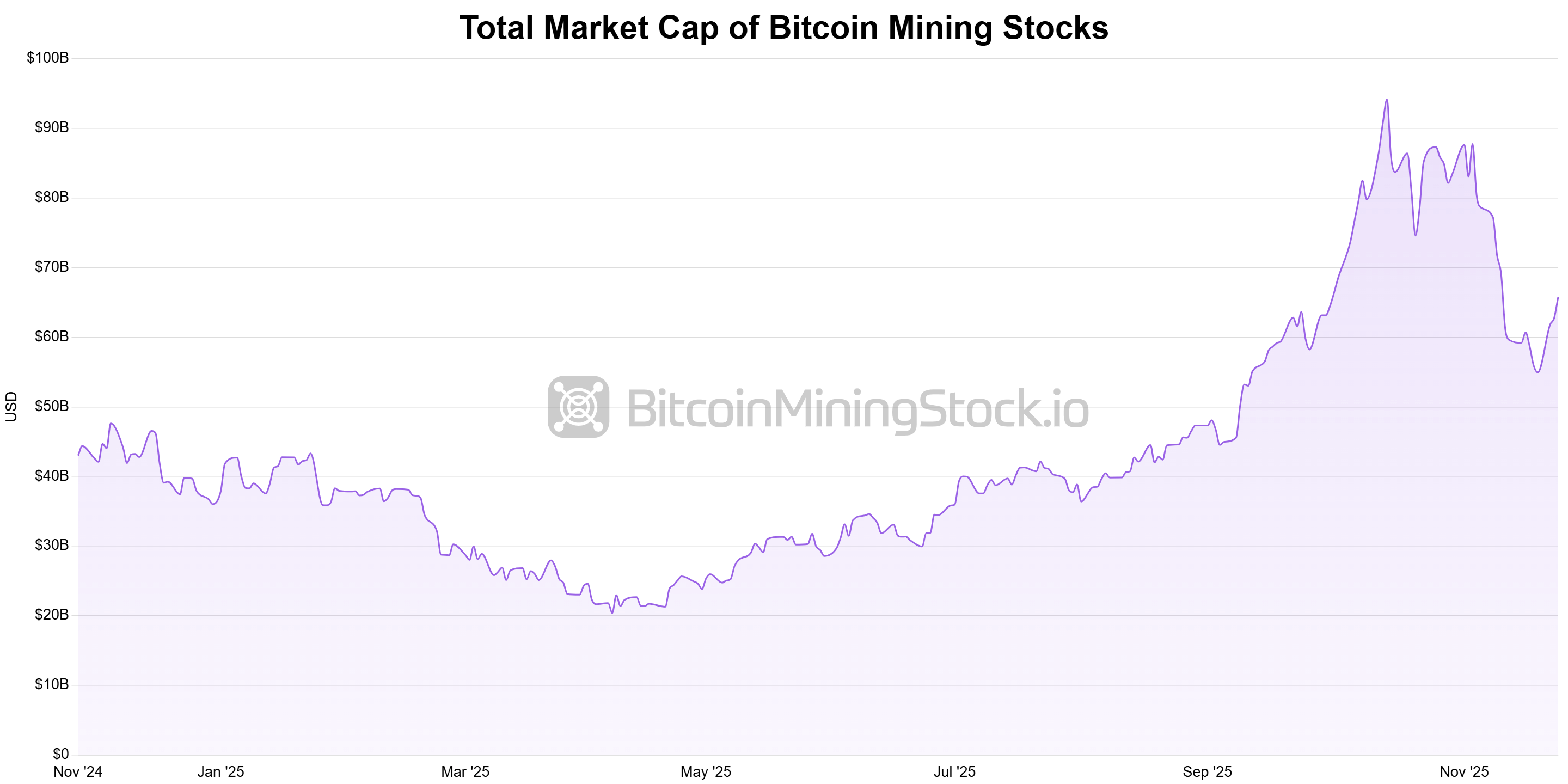
These BTC miners saw their stock slide from a peak near $87 billion to about $55 billion before a partial rebound toward $65 billion.
What to Watch Next
Considering this, industry players are monitoring three specific dials to gauge the next phase of this restructuring.
The first is difficulty: deeper negative retargets would confirm rolling shutdowns among high-cost fleets. A sharp snapback would imply sidelined capacity is re-energizing as power contracts reprice or as fee spikes return.
The second is transaction fees. Inscription waves and persistent mempool congestion can lift miner revenue for weeks at a time, but the base case is a lean fee environment that keeps hashprice pinned near breakeven for many fleets.
The third is policy and supply chain. Any escalation in export controls, security reviews, or grid interconnection rules could shift the cost of capital overnight.
Miners have already begun adapting by broadening their business mix. Many are repositioning as data infrastructure firms, signing multiyear contracts for AI and high-performance computing to smooth cash flow that Bitcoin alone cannot guarantee.
That model can preserve marginal sites and retain upside exposure if the hash price recovers. Still, it also pulls scarce power toward steadier margins, leaving Bitcoin as the flexible sink that absorbs volatility.
For Bitcoin, the immediate risk is not a collapse in security. The zettahash era has delivered record aggregate work, and the protocol continues to calibrate on schedule.
The risk is structural: a system that looks healthier by aggregate metrics while relying on fewer actors to provide the work.
If capital remains tight and energy costs stay elevated, more asset sales, mergers, and migrations toward friendly jurisdictions are likely. However, if prices and fees rebound, some of today’s idled capacity will return, but often under new owners and new power terms.
That is the paradox of the zettahash age. At the protocol level, Bitcoin has never looked stronger. Beneath the surface, the mining business is facing significant distress.