



Could early access to a crypto project be an opportunity or a hidden risk waiting to unfold?
Crypto presales continue to attract attention from both new and experienced investors. As blockchain startups seek early-stage funding, presales allow participants topurchase tokens before they reach public exchanges. While this early access often appears attractive, it also comes with risks that beginners must clearly understand.
Therefore, this guide explains how crypto presales work, why projects launch them, and how first-time investors can evaluate presale opportunities responsibly in today’s evolving crypto market.
What Is a Crypto Presale?
A crypto presale is an early fundraising phase in which blockchain projects sell tokens directly to participants before a public launch. In most cases, presales take place ahead of an initial DEX offering or centralized exchange listing.
Typically, tokens are sold at a fixed price, often lower than the expected public listing price. As a result, presales help projects raise capital for development, marketing, and ecosystem growth while building an early user community.
At the same time, presales remain largely unregulated in many jurisdictions. This means investors must rely on their own research rather than the protections found in traditional financial markets.
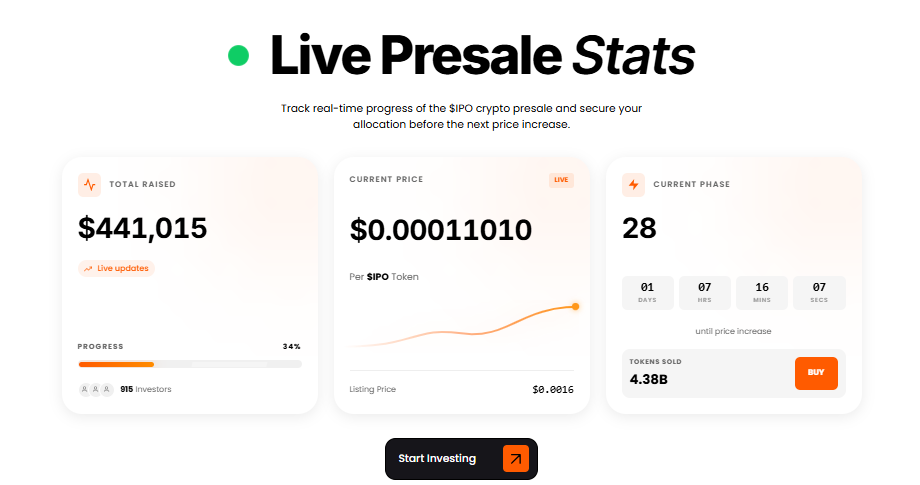
In recent market activity, several early-stage blockchain projects have launched token presales to fund development and community growth. For example, the IPO Genie ($IPO) presale is live at the time of writing, reflecting a broader trend of projects using presale structures to raise capital ahead of public exchange listings.
Why Crypto Projects Launch Presales
Crypto teams use presales for several strategic reasons.
- First, presales allow projects to secure funding without depending entirely on venture capital. This can support broader token distribution and community participation.
- Second, presales help teams measure market interest before a full launch. Strong participation can signal demand, while limited interest may reveal weaknesses early.
- Finally, presales are often tied to roadmap milestones such as testnet releases, mainnet launches, or protocol upgrades.
According to documentation from the Ethereum Foundation, early community funding has historically played a role in bootstrapping decentralized networks.
Common Types of Crypto Presales
Not all crypto presales follow the same structure. Understanding these differences helps beginners assess transparency and risk more effectively.
| Presale Type | Description | Key Risk Factors |
| Private Sale | Limited access for early backers or institutions | High centralization risk |
| Whitelist Sale | Open to approved wallets after registration | Allocation limits |
| Public Presale | Open participation via the project website or the launchpad | Smart contract risk |
| Launchpad Sale | Hosted by third-party platforms | Platform dependency |
This comparison helps investors understand how access, control, and risk can vary across presale formats.
How Crypto Presales Typically Work
Most crypto presales follow a predictable process. First, the project releases documentation, such as a
- whitepaper,
- roadmap, and
- tokenomics overview.
After that, the team announces presale terms, including token price, accepted cryptocurrencies, and participation limits.
Next, investors connect a crypto wallet and send funds to a smart contract address. Tokens may be distributed immediately or released gradually through vesting schedules. Vesting has become increasingly common, especially after past market failures highlighted liquidity and dumping risks.
This process structure is consistent across many active token launches, including cases where the IPO Genie presale is live and following standard presale mechanics such as published tokenomics and predefined participation terms.
Key Factors to Evaluate Before Investing
Before participating in any crypto presale, due diligence is essential. First, examine the team behind the project. Public identities, relevant blockchain experience, and transparent communication are important credibility indicators.
Next, review the whitepaper carefully. It should clearly explain the problem being addressed, the proposed solution, and the token’s long-term utility. Vague explanations or unrealistic claims are often warning signs.
In addition, tokenomics deserve close attention. Investors should analyze total supply, allocation percentages, and vesting schedules. According to Binance Research, poorly designed token distribution is one of the most common causes of post-launch price instability.
Finally, verify whether the smart contract has undergone a security audit. Established firms such as CertiK and Hacken publish audit reports that are publicly accessible.
Even when presale details are visible on public platforms, including sites like IPO Genie, investors should verify all claims directly through official project documentation. Presale listings and summaries can help with discovery, but responsibility for due diligence ultimately remains with the investor.
Risks Beginners Should Understand
While presales can be appealing, they carry significant risks that beginners must consider carefully:
- Limited Liquidity: Tokens may not be immediately tradable after launch, making exits difficult.
- Project Delays: Development timelines can slip, extending vesting or token release schedules.
- Smart Contract Vulnerabilities: Poorly audited contracts increase the risk of exploits or fund loss.
- Market Volatility: Token prices may decline sharply once public trading begins.
- Scams and Fraud: Misleading roadmaps and fake teams remain a concern, as highlighted by Chainalysis reports.
Because of this, presales should never be viewed as guaranteed opportunities. Instead, they should be treated as high-risk, early-stage investments.
The Regulatory Landscape Around Presales
Globally, crypto presales operate in a regulatory gray area. In the United States, regulators such as the Securities and Exchange Commission continue to scrutinize token sales that resemble unregistered securities offerings.
Meanwhile, regions such as the European Union are moving toward clearer oversight frameworks under the Markets in Crypto-Assets regulation. As regulations evolve, compliance and transparency are becoming increasingly important indicators of project legitimacy.
A Clear Perspective for First-Time Presale Investors
Crypto presale investing can provide early exposure to emerging blockchain projects, but it also demands careful research and realistic expectations. Understanding how presales work, evaluating teams and tokenomics, and recognizing regulatory and security risks are essential steps for beginners.
Ultimately, presales are neither inherently good nor bad. Their value depends on informed participation, disciplined risk management, and an objective assessment of each project’s fundamentals.
Disclaimer: This content is for informational purposes only and does not constitute financial or investment advice. Cryptocurrency investments involve risk. Readers should conduct their own research before making any decisions.