


Listen to the article
With S2F in the rearview, the live power-law channel indicates that BTC is roughly 20% below fair value, but ETF flows could push it to either extreme.
Bitbo’s implementation of Giovanni Santostasi’s model places the price near $109,700, the fair value near $136,100, the support near $48,300, and the resistance near $491,800, which frames the current cycle within a rising corridor derived from a power-law fit to price over time.
The channel is constructed by running a linear regression of log(price) versus log(time since genesis), then duplicating that line in parallel to form upper and lower bounds that have historically contained cyclical extremes.
The result is a time-based compounding curve with rails that move upward as time passes, making the model more of a location map than a point forecast.
The core claim is simple to evaluate in live markets. Bitcoin trades about 20 percent below the fair-value regression and more than twice above the model’s floor, a mid-zone placement that contrasts with prior cycle tops and bottoms when the price tagged the channel’s resistance or support.
Parameterization used by BGeometrics expresses the fair-value curve as P ≈ 1.0117×10^-17 × (days since genesis)^5.82, with a commonly referenced floor at about 0.42 times the curve, which is consistent with the present gap between spot price and Bitbo’s lower rail.
The specification includes historical drawdowns while allowing for late-cycle overextensions toward the upper band.
The logic behind this approach treats adoption as a power function of time and expects volatility to decay as the network matures, a property that appears as tightening oscillations around the regression line over successive cycles.
Bitcoin holds its power-law lane as ETFs rewrite the cycle
Recent flows help explain why the price is in the channel’s middle rather than at an extreme. Crypto exchange-traded products (ETPs) drew a record $5.95 billion in net inflows during the week ending October 4, 2025, with Bitcoin reaching an all-time high of approximately $126,000, alongside strong demand for U.S. spot Bitcoin ETFs.
The following two weeks showed that flows are not a one-way input. CoinShares recorded a swing to $3.17 billion of net inflows, followed by a reversal to $513 million of net outflows, including a single-week Bitcoin outflow of $946 million.
Over the last two days alone, $958 million has exited US Bitcoin ETFs, with $290 million leaving BlackRock on October 30.
That cadence is consistent with the power-law framing, where transitory demand surges or air pockets push price toward the upper or lower rails over weeks, while the long-run trajectory is anchored to the time-based power curve. October highs were tied to the breakout wave of ETF subscriptions, which are now a visible macro lever for crypto demand.
The forward question, therefore, is not whether the power-law structure still applies, but where within the channel Bitcoin will trade over the next leg.
A base-case path keeps the price oscillating around the regression, currently near $136,100, with a dampened amplitude if the volatility decay property holds.
A bull-case path would see continued ETF inflows and benign macro conditions pull the price toward the upper resistance, near $491,800 today, which prior cycles reached during late-stage runs.
A bear-case scenario would arise from macro tightening, a regulatory shock, or persistent ETF outflows that drive a retest of the lower rail near $48,300. This level has historically seen capitulation wicks before reentry into the channel.
These levels rise with time as the exponent on days since genesis compounds. The rails are directional guardrails, not fixed targets.
For readers tracking levels at a glance, the live model ranges are:
| Measure | Level |
|---|---|
| Spot price | ≈ $109,700 |
| Fair-value regression | ≈ $136,100 |
| Support (floor band) | ≈ $48,300 |
| Resistance (upper band) | ≈ $491,800 |
The debate over model choice is shaped by the breakdown of the once-popular Stock-to-Flow approach.
PlanB’s S2F path called for $98,000 by November 2021 and $135,000 by December 2021, targets that were not met.
The price then spent years below the S2F trajectory, an out-of-sample failure that weakened confidence in using a univariate stock-to-flow ratio to set deterministic targets.
Vitalik Buterin has criticized S2F for providing false precision, and many analysts have identified methodological issues, including overfitting, the omission of demand and liquidity variables, and the treatment of halvings as step-wise valuation shifts that do not account for market microstructure.
Institutional researchers continue to caution that S2F is not a reliable tool for long-term pricing. That leaves S2F as a scarcity narrative rather than a forecasting model.
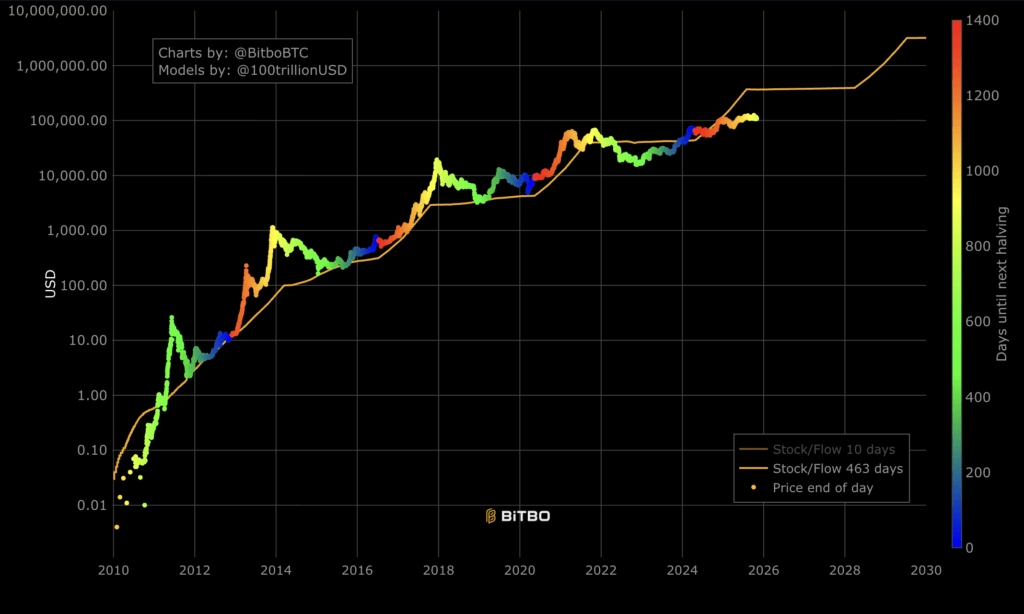
Power-law adherents, by contrast, argue that the cycle length and amplitude can be bounded without hard-dating outcomes.
CryptoSlate has previously outlined broad windows in which Bitcoin would not sustain prices below roughly six figures after 2028 and could, at some point between 2028 and 2037, touch the seven-figure mark.
Those are ranges, not calendar calls, and they inherit the same caveats as any model that ignores policy shocks or structural changes in market access.
The new structural change is ETF flow, which functions as a demand valve that can overpower the marginal issuance cuts that halvings encode.
Sustained weekly spot inflows above $2 billion to $3 billion would raise the odds of an upper-band test, while persistent outflows would increase the probability of a regression or floor retest.
Macro liquidity, including the path of rates, the dollar, and central bank balance sheets, still takes center stage in determining whether the price holds above the regression or drifts toward the lower rail. That macro overlay is absent in S2F and is only indirectly present in the power-law fit, which is why practitioners track flows and policy alongside the channel.
Method clarity is crucial given the model’s increasing use in institutional decks.
The power-law channel is constructed by taking daily BTCUSD closes, transforming them to log(price) versus log(time since genesis), fitting a simple linear regression as the fair-value curve, and then copying that line up and down in parallel to form resistance and support that historically enclose the price.
The elegance lies in its production of a monotonically rising, time-based framework with a visible margin of error, which, so far, has captured cycle extremes without claiming to know the date or magnitude of future blow-offs.
The cost is that it does not mechanistically incorporate known drivers, such as ETF demand or liquidity cycles, which must be monitored to understand where within the channel price is likely to reside in the near term.
For now, the live read is straightforward. Price sits about one-fifth below the regression, well above the floor, with ETF flows and macroeconomic conditions determining whether Bitcoin tags the upper band or fades toward support before reverting to the mean.
The channel continues to rise with time, and the rails define the tradable map.