

Listen to the article
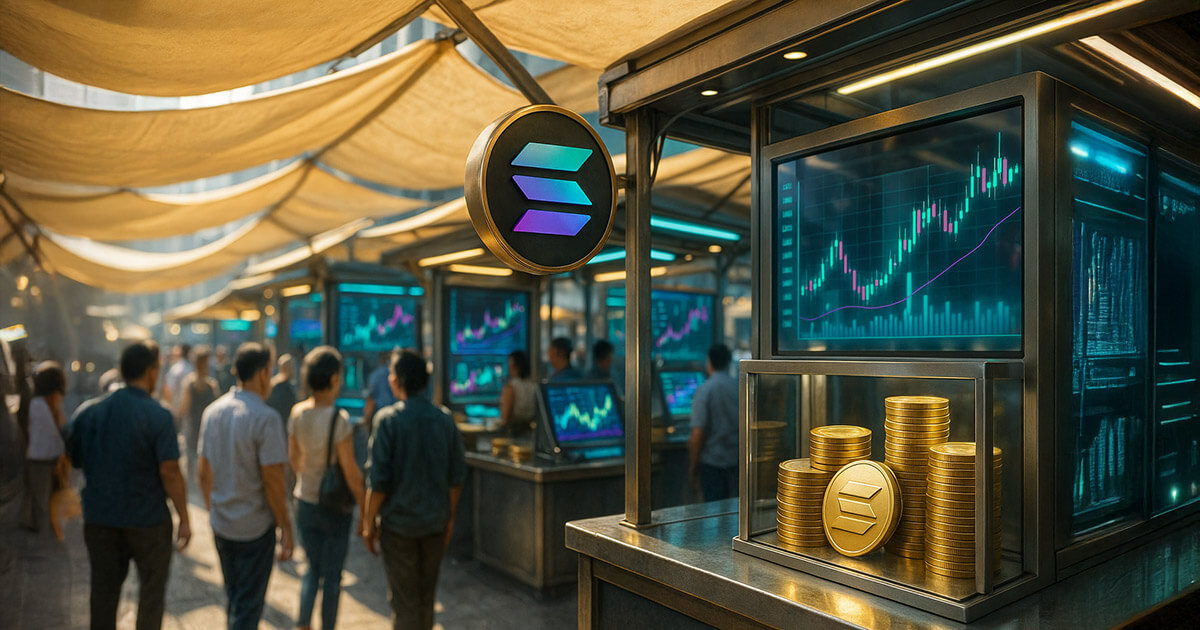
Grayscale, one of crypto’s largest institutional asset managers, published a research note on Oct. 10 calling Solana (SOL) “crypto’s financial bazaar.”
This characterization goes well beyond the usual speed-and-throughput pitch. The report positions SOL as the category leader in users, transactions, and fees, arguing that its user experience, architectural moat via the Solana Virtual Machine, and application diversity create a durable foundation for valuation.
It’s a significant shift in institutional tone. Grayscale is now giving Solana the same treatment it once reserved for Ethereum as “digital oil.”
The thesis matters less for what Grayscale believes than for what it signals. When a major allocator aligned with the traditional finance ecosystem formalizes an investment case around a blockchain that was left for dead after FTX collapsed, other desks take notice.
The question is whether the numbers support the narrative, or whether “financial bazaar” is still more metaphor than measurable reality.
We stress-tested Grayscale’s claims against primary on-chain data, developer trackers, and technical benchmarks. The direction is right: Solana leads on several key metrics.
However, the institutional case carries trade-offs that the report acknowledges only in passing, and a few headline figures deserve closer scrutiny.
What Grayscale says
The report frames Solana as the standout among smart contract platforms on three core fundamentals: users, transaction volume, and fees.
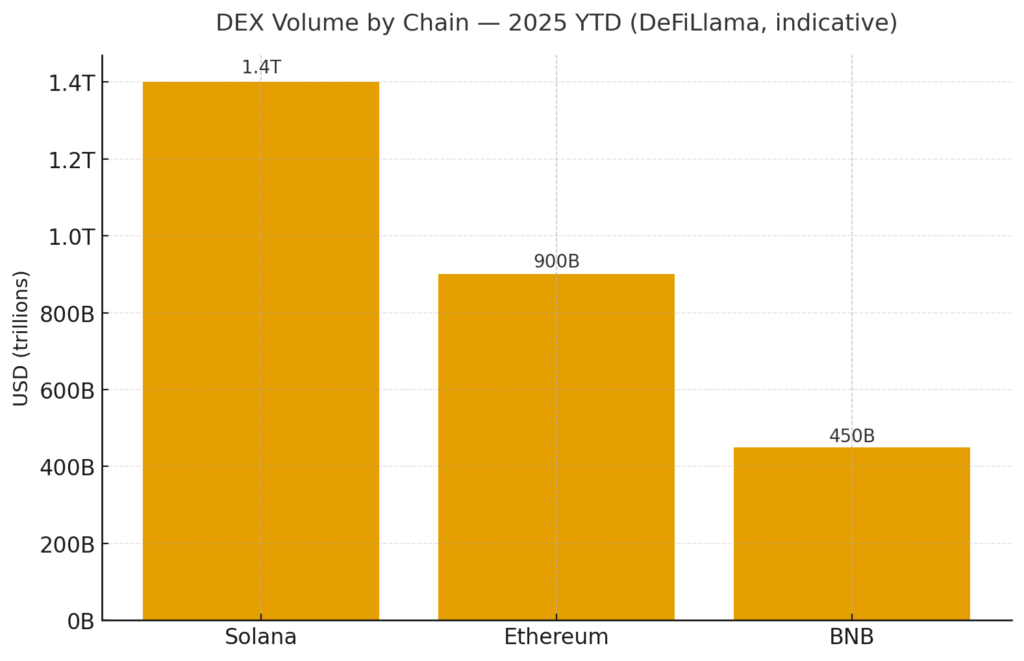
Grayscale cites roughly $425 million in monthly ecosystem fees, an annualized run rate above $5 billion, and points to $1.2 trillion in year-to-date DEX volume routed through Raydium and Jupiter.
It highlights Jupiter as the largest DEX aggregator by volume in the industry, Pump.fun’s 2 million monthly active users, and Helium’s 1.5 million daily users as proof of application diversity.
On the developer side, the report notes more than 1,000 full-time Solana developers and claims the ecosystem has grown faster than any other smart contract platform over the past two years.
Speed and cost receive equal billing. Solana produces blocks every 400 milliseconds, with transactions considered final in roughly 12 to 13 seconds.
Average transaction fees sit at $0.02, while median daily fees this year have averaged $0.001, one-tenth of one cent, thanks to local fee markets that isolate congestion to specific high-demand applications.
A forthcoming upgrade called Alpenglow aims to reduce finality to 100 to 150 milliseconds.
Grayscale also draws boundaries. It explicitly states that SOL “may be less suitable as a long-term store of value than Bitcoin or Ethereum,” citing higher nominal supply inflation and centralization vectors.
The report noted that Solana’s efficiency comes at the cost of comparatively high hardware and bandwidth requirements, with 99% of staked SOL in data centers and roughly 45% concentrated in the top two hosting providers.
What the numbers show
DeFiLlama shows Solana consistently running around 2.6 million active addresses in the last 24 hours and roughly 67 million on-chain transactions over the same window, in line with 2025’s typical pace.
Artemis reporting from mid-2025 highlighted that Solana matched all other layer-1 and layer-2 networks combined on monthly active addresses, corroborating the “category leader” characterization on user count.
Regarding fees, the “$425 million per month” figure requires context. Token Terminal’s chain-level fee data for Solana show tens of millions per month in several 2025 periods, around $30 million to $40 million in recent months.
DeFiLlama shows current daily chain fees around $0.8 million to $1.6 million and app fees around $9 million to $13 million, together implying roughly $300 million to $450 million per month at the recent pace, depending on market intensity.
Hundreds of millions per month during busy periods is plausible, but $425 million as a steady baseline overstates the run rate. The mix between chain fees and app fees also matters for apples-to-apples comparisons across networks.
The report also addressed volumes. DeFiLlama’s chain dashboard shows Solana regularly posting multi-billion-dollar daily DEX volume and more than $40 billion in the last seven days, with multiple recent days topping Ethereum.
Weekly, Solana topped Ethereum’s volumes for 33 out of 42 weeks this year.
Jupiter currently ranks as the industry’s largest DEX aggregator by 30-day volume, roughly $22.3 billion versus $13 billion to $14 billion for 1inch, supporting Grayscale’s claim.
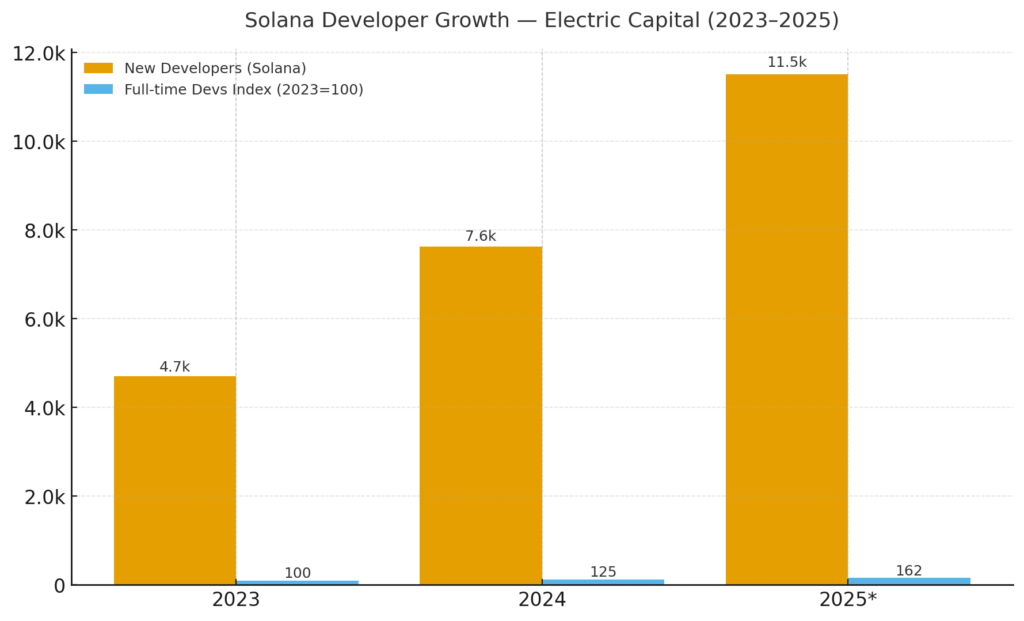
For the active developer base, Electric Capital’s live tracker shows Solana with approximately 17,708 total developers as of mid-October 2025, with the full-time developer base up 29.1% year over year and 61.7% over two years.
The ecosystem attracted 7,625 new developers in 2024, the most of any chain, and has added more than 11,500 new developers year to date through mid-October 2025.
That places Solana second only to Ethereum in active developers, confirming the “large and growing” characterization.
On finality and speed, Chainspect reports Solana slot time around 0.4 seconds and typical finality at roughly 12.8 seconds today, aligning with Grayscale’s 12- to 13-second claim.
Additionally, Helius’ technical documentation on local fee markets explains how Solana sustains high throughput while keeping median user fees in fractions of a cent, even during congestion.
The data directionally support the thesis that Solana leads in active users, often leads in DEX flow, hosts the largest aggregator, and ranks second in developers.
The fee claim is accurate during hot markets but overstates the steady-state baseline.
Why institutions are warming up now
Institutions are warming to Solana because the user experience is now measurably fast, cheap, and more predictable.
Local fee markets keep most congestion and priority fees localized to hot applications, so everyday transactions stay inexpensive even when activity spikes, something custodians and venues value when they batch flows or settle client orders.
Chainspect measures roughly 0.4-second block times and 12.8-second finality today, and the Alpenglow upgrade targets sub-second finality, reducing settlement risk windows for market makers and brokers.
Reliability has improved since the mainnet halt on Feb. 6, 2024, which lasted about five hours. Yet, data shows stronger uptime and throughput in subsequent months.
Liquidity has deepened across both DEX and aggregator rails, which matters for execution and hedging.
DeFiLlama shows Solana regularly at or near the top in chain-level DEX volumes. At the same time, Jupiter ranks as the largest DEX aggregator by 30-day volume, giving institutions a single router into pooled liquidity across Raydium, Orca, Meteora, and others.
Token Terminal data also shows rising fee capture on Solana’s stack, chain plus apps, a proxy for sustained user demand that supports tighter spreads and deeper books.
Post-FTX, the ecosystem has rebuilt credibility and infrastructure. The Artemis report already mentioned suggests that the user base and throughput weren’t just hype cycles.
On the product side, a regulated-product pipeline has emerged, with multiple spot SOL exchange-traded funds (ETFs) applications pending before the US government shutdown paused SEC reviews, signaling mainstream issuers’ interest, even if the timing has slipped.
Together, user traction and visible institutional wrappers lower the perceived idiosyncratic risk that kept some desks sidelined in 2023.
The structural trade-offs
Grayscale acknowledges centralization but only in outline. Running a high-quality validator still assumes server-class hardware, 12-plus cores, AVX2/512 instruction sets, NVMe arrays, and 256GB-plus RAM, which raises the barrier to entry and pushes operators toward data centers.
Solana’s effective decentralization, measured by the Nakamoto coefficient, stood at 20 as of Apr. 16, 2025, down from a higher peak, meaning fewer entities would need to collude to censor transactions than in periods when the coefficient was larger.
Client diversity remains in transition. The Agave and Jito clients still dominate Solana, while Firedancer is progressing but has only run in limited or non-voting configurations, with full rollout targeted for 2025.
Until Firedancer and other clients are widely adopted, single-client risk persists.
Store-of-value headwinds stem from issuance and fee policy. The current annual issuance ranges from 4% to 5%, with a disinflationary path toward a lower long-term target, higher than Bitcoin’s fixed schedule and capable of diluting holders absent offsetting burn.
Following SIMD-0096, only 50% of the base fee is burned, and the priority-fee burn has been discontinued, weakening the burn counterweight when activity shifts toward priority fees.
High throughput drives large ledgers, frequent snapshots, and upgrade cadence.
Recommended setups include multiple high-TBW NVMe devices for accounts, ledgers, and snapshots, which raises ongoing operational costs compared to lighter chains.
Grayscale’s Solana thesis, which posits that fast, cheap, and sticky applications yield sustainable network value, holds up on the fundamentals that matter most to institutions: active users, transaction throughput, developer pipeline, and liquidity depth.
The “financial bazaar” framing is more than marketing, as Solana hosts a diverse and dense on-chain economy that rivals or exceeds its peers on multiple dimensions.
Yet, the caveats matter. The $425 million monthly fee figure is a high-water mark, not a baseline. Centralization vectors, centered around hardware requirements, stake concentration, and client diversity, are real, even if they haven’t yet impaired network operations.
And the store-of-value limitation Grayscale draws is a deliberate line. SOL is a utility and speculation vehicle, rather than a monetary asset in the sense of Bitcoin or Ethereum.
The following milestones to watch are Alpenglow’s finality upgrade and Firedancer’s full deployment.
If Solana can deliver sub-second finality while diversifying its client base, the institutional case strengthens. If hardware requirements continue to push validators into data centers and the Nakamoto coefficient drifts lower, the “bazaar” risks becoming a walled garden.