



JPMorgan Chase is reviewing whether to offer cryptocurrency trading services to its institutional clients, signaling another shift in how major banks engage with digital assets. The discussions, first reported by Bloomberg and later confirmed by Reuters, include potential spot and derivatives crypto trading products. While the review remains preliminary, it reflects growing institutional demand for regulated access to crypto markets.
No final decision has been made, and any rollout would depend on client interest, internal risk limits, and regulatory feasibility. Still, the move underscores how Wall Street banks are increasingly reassessing crypto as client demand and market infrastructure mature.
JPMorgan Evaluates Spot and Derivatives Crypto Trading
According to people familiar with the matter, JPMorgan’s markets division is exploring whether it can expand into cryptocurrency trading for institutional customers. The review includes spot trading as well as derivatives linked to digital assets.
The initiative is still in early stages. JPMorgan has declined to comment publicly, and Reuters noted it could not independently verify some details of the discussions. Executives have indicated that any product launch would be contingent on sufficient demand and risk approval.
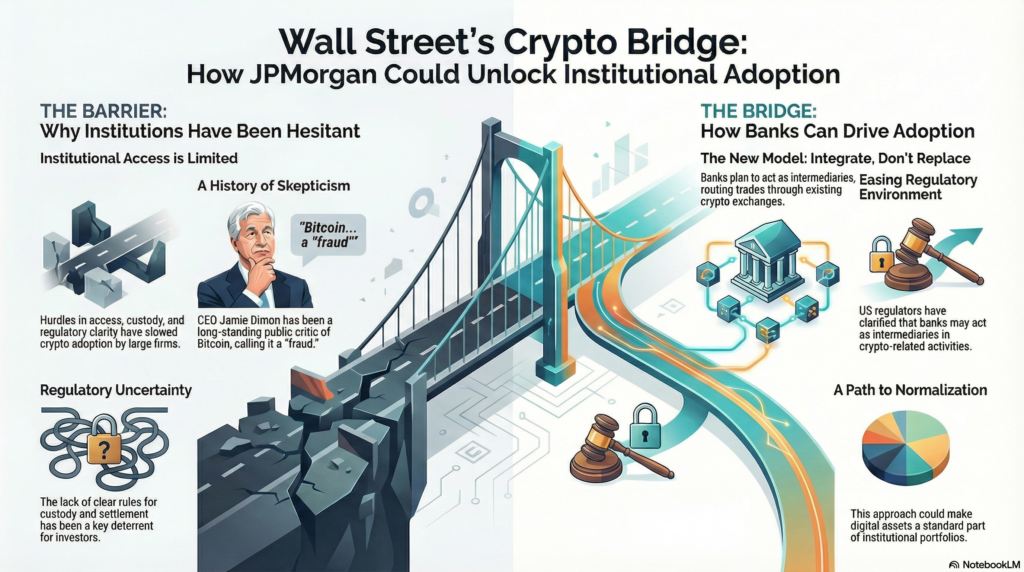
Rather than building a standalone crypto exchange, JPMorgan appears focused on acting as an intermediary. Under this model, the bank would route institutional orders through existing crypto exchanges and custodial platforms, similar to how banks operate in commodities and other alternative asset markets.
Banks Look to Integrate, Not Replace, Crypto Market Infrastructure
Market participants say JPMorgan’s approach reflects a broader trend among global banks. Instead of replacing crypto-native infrastructure, banks are increasingly looking to integrate with it.
By routing trades through established exchanges, banks can offer clients exposure to crypto markets without disrupting existing liquidity venues. This approach allows traditional institutions to meet compliance and governance requirements while leveraging platforms already designed for digital asset execution and settlement.
Analysts note that this structure could convert latent institutional demand into visible trading volumes across crypto markets. Hedge funds, asset managers, and pension funds have shown interest in digital assets for years, but access, custody,
and regulatory clarity has often slowed adoption.
Crypto Firms Positioned as Execution Partners
JPMorgan’s potential entry could benefit crypto-native firms that already serve institutional clients. Platforms such as Coinbase Prime, Bullish, and Galaxy Digital provide institutional-grade trading, custody, and settlement services.
“If JPMorgan offers crypto trading to institutional clients, it will be a big positive to the space,” said Owen Lau, an analyst at ClearStreet. He added that such a move would further legitimize crypto markets and expand distribution channels.
Lau noted that large banks are likely to rely on external venues to match and clear trades. That dynamic could deepen the role of crypto firms as execution and infrastructure partners rather than marginalize them.
Compass Point analyst Ed Engel echoed that view in a recent research note, writing that Wall Street participation expands the addressable market for digital assets. However, he cautioned that increased competition could place pressure on trading fees, particularly for lower-touch spot trading services.
Competition and Margin Pressure Could Increase
While institutional participation may lift volumes, it may also intensify competition among service providers. Engel pointed out that firms offering basic execution services could see margin compression as banks and large institutions enter the market.
He highlighted Galaxy Digital as a potential beneficiary due to its focus on principal trading, derivatives, and high-touch prime brokerage. Bullish, he added, may also benefit from its relatively low spot trading fees.
At the same time, growth in institutional trading could drive demand for related services such as lending, collateral management, and custody. These areas rely heavily on infrastructure already built by crypto-native firms, reinforcing their role in the evolving market structure.
Regulatory Shifts Support Institutional Entry
JPMorgan’s review comes amid shifting regulatory conditions in the United States. Banking regulators have recently clarified that federally chartered banks may act as intermediaries in certain crypto-related activities, provided they meet compliance and risk standards.
Market participants also expect progress on federal digital asset legislation, which could further reduce uncertainty for institutions considering crypto exposure. Clearer rules around custody, settlement, and reporting have been a key requirement for many large investors.
Reuters reported that JPMorgan’s deliberations reflect broader warming across Wall Street as regulatory barriers begin to ease. Other banks are moving in parallel. Morgan Stanley plans to offer crypto trading on its E*Trade platform in 2026 through a partnership with Zerohash, while Standard Chartered has launched spot bitcoin and ether trading in the U.K.
Jamie Dimon’s Evolving Stance on Digital Assets
JPMorgan’s exploration of crypto trading also highlights the contrast between the bank’s operational strategy and CEO Jamie Dimon’s long-standing skepticism toward bitcoin.
Dimon famously called bitcoin a “fraud” in 2017 and later compared it to “tulip bulbs” and a “pet rock.” He has repeatedly warned about speculative excess and criticized decentralized tokens in public forums, including testimony before the U.S. Congress.
In recent years, however, Dimon has drawn a clearer distinction between crypto assets and the underlying technology. By late 2025, he acknowledged that “blockchain is real” and that stablecoins have legitimate use cases. While he continues to advise individuals against investing in bitcoin, he has defended clients’ right to do so, framing it as a matter of market choice.
Blockchain Expansion Continues Beyond Trading
Even without direct crypto trading, JPMorgan has steadily expanded its blockchain footprint. In December 2025, the bank arranged a $50 million short-term bond for Galaxy Digital on the Solana blockchain, using USDC for both issuance and redemption.
The firm has also allowed institutional clients to use bitcoin and ether as collateral in lending arrangements, reducing the need for forced liquidations. These efforts are coordinated through Kinexys, JPMorgan’s rebranded digital asset division.
Kinexys recently launched the MONY tokenized money market fund on Ethereum and introduced programmable JPMD deposit tokens on Base, enabling near real-time settlement for institutional transactions.
What JPMorgan’s Review Signals for Adoption
JPMorgan’s internal review does not guarantee a new crypto trading desk. However, it illustrates how institutional adoption is increasingly shaped by distribution, compliance, and integration rather than ideological debates about crypto itself.
Large investors continue to seek exposure through trusted intermediaries with strong balance sheets and operational resilience. By positioning itself as a broker rather than an exchange, JPMorgan could help bridge institutional capital with existing crypto liquidity.
If the bank proceeds, it may accelerate a model in which traditional finance and crypto-native firms coexist, each playing complementary roles. For the broader market, that convergence could mark another step toward digital assets becoming a normalized part of institutional portfolios rather than a niche alternative.
JPMorgan’s review reflects how institutional adoption of crypto is increasingly driven by access and infrastructure rather than ideology. By integrating with existing markets instead of replacing them, banks may accelerate institutional participation without disrupting current liquidity.
If implemented, the approach could further normalize digital assets within traditional financial systems.
Disclaimer: This content is intended solely for informational and educational purposes. It does not constitute investment advice, an offer, or a solicitation to buy or sell any financial instruments or digital assets. The publisher and authors are not responsible for any financial losses resulting from actions taken based on this information.