


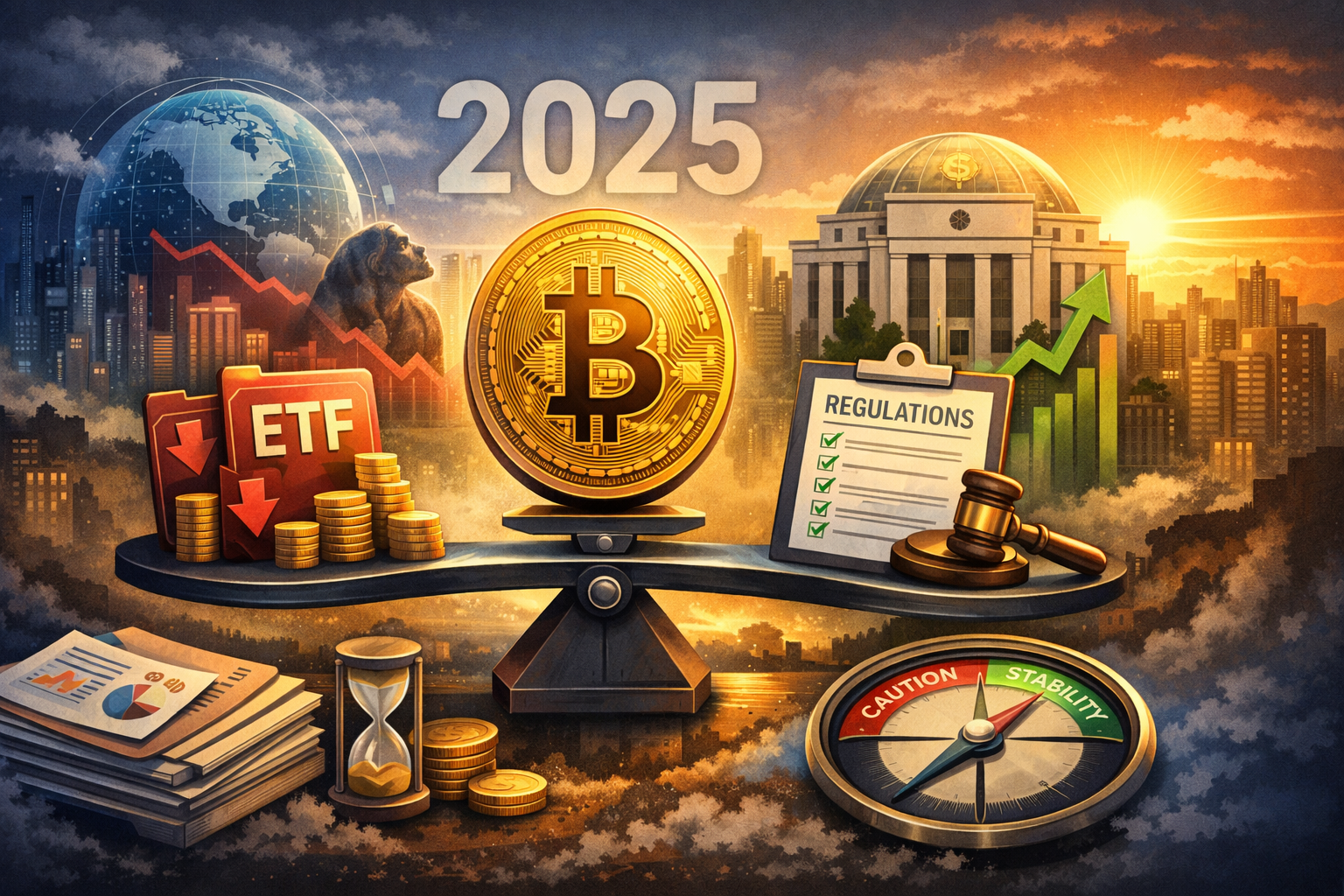
Bitcoin’s story in late 2025 is about adjustment. New crypto regulations are reshaping how institutions operate, while Bitcoin exchange-traded funds are seeing capital flow out rather than in. Together, these forces are quietly influencing price behavior.
This shift does not mean Bitcoin is failing. It means the market is maturing.
Over the past year, Bitcoin and Ethereum both reached new highs before pulling back. At the same time, traditional assets like gold and equities outperformed crypto during several periods. Investors began reassessing risk, exposure, and timing. The result is a calmer but more structured market environment.
This article explains what changed, why it matters, and what it means for Bitcoin heading into 2026.
What Changed in 2025
The crypto market in 2025 looked very different from earlier cycles. Regulation moved from vague guidance to clearer frameworks across major jurisdictions. Governments focused less on banning crypto and more on defining how it should operate within financial systems.
At the same time, spot Bitcoin ETFs (exchange-traded funds) changed how institutions interact with the market. These products brought transparency and structure, but they also introduced discipline. Capital now moves based on macro conditions, risk models, and portfolio balance rather than speculation alone.
This shift matters. Bitcoin is no longer driven mainly by retail enthusiasm. It now responds to policy decisions, liquidity conditions, and institutional positioning.
Regulation did not kill momentum. It was made better.
Why ETF Outflows Matter
In late 2025, spot Bitcoin ETFs recorded notable outflows. During one holiday week alone, over $780 million exited U.S.-listed Bitcoin ETFs. This data was reported by Binance and other market trackers, reflecting a broader trend of risk reduction rather than panic selling.
These outflows did not mean institutions lost faith in Bitcoin. Instead, they reflected portfolio rebalancing, year-end risk management, and uncertainty around global economic conditions.
When institutions reduce exposure, prices often cool. That does not signal failure. It signals caution.
ETF flows once pushed prices upward quickly. Now, the same tools are being used to manage risk. This is a sign of maturity, not weakness.
Bitcoin’s Position in Late 2025
Bitcoin spent much of late 2025 trading sideways. Volatility declined compared to earlier cycles. This behavior confused many retail traders, but it aligns with how maturing asset classes behave.
Price action became increasingly influenced by macroeconomic factors such as interest rates, liquidity conditions, and regulatory clarity. Bitcoin moved less on hype and more on fundamentals.
This period of consolidation suggests the market is waiting for direction rather than collapsing. Bitcoin is not weak. It is patient.
The Role of Regulation
One of the biggest shifts in 2025 was regulatory clarity.
Several regions introduced clearer frameworks for digital assets, including custody rules, reporting standards, and compliance requirements. These changes reduced uncertainty for institutions and encouraged long-term planning.
While regulation can slow momentum in the short term, it builds trust over time. Institutions operate best when rules are defined. The result is a market that favors stability over speculation.
Bitcoin is increasingly treated as infrastructure rather than a speculative experiment.
Why Bitcoin Is Moving Sideways
Bitcoin’s sideways movement in late 2025 reflects balance, not weakness.
On one side, long-term holders remain active. Wallet data and on-chain metrics show continued accumulation among patient investors. On the other side, institutions are cautious, waiting for clearer economic signals before increasing exposure.
This push and pull creates stability. Prices do not collapse, but they also do not surge.
In past cycles, this phase often came before the next structural move. Not because of hype, but because the foundation was quietly strengthening.
What Comes Next
The next phase for Bitcoin depends on several conditions.
First, regulatory clarity must continue improving. Clear rules reduce uncertainty and encourage long-term capital.
Second, ETF flows need to stabilize. When institutions stop reducing exposure, confidence tends to return.
Third, macroeconomic conditions must support risk assets. Lower inflation, steady rates, and improving liquidity would help.
None of these factors guarantee growth. But together, they create an environment where Bitcoin can move with purpose rather than speculation.
A Market in Transition
The story of late 2025 is not about collapse or hype. It is about transition.
Bitcoin is adjusting to a world where rules exist, capital is cautious, and growth must be earned. This is how mature markets behave. It is uncomfortable, slower, and less exciting than previous cycles, but it is also more sustainable.
Investors who understand this shift are better positioned than those chasing short-term moves.
Final Thoughts
Bitcoin’s evolution in 2025 reflects a broader change in how digital assets are viewed. They are no longer experimental tools. They are financial infrastructure.
Prices will continue to move. Volatility will return at times. But the foundation being built now matters more than any short-term chart pattern.
For investors, the lesson is simple. Focus less on noise and more on structure. Understand risk. Stay informed. Let time and discipline do the work.
This is not the end of Bitcoin’s story. It is the next chapter.
Disclaimer: This article is for informational purposes only and does not constitute financial advice. Always conduct independent research before investing.